
VG: A Vaper's Guide to Vegetable Glycerin & PG/VG Ratios
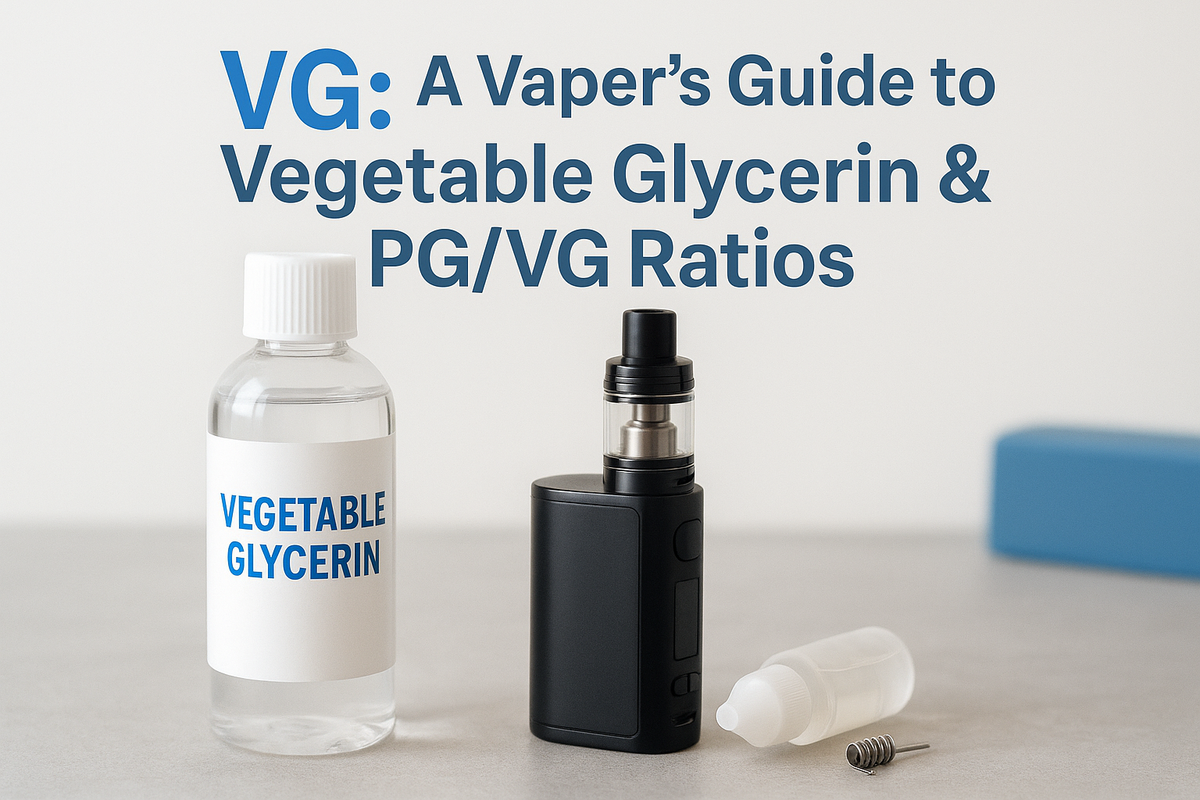
VG (Vegetable Glycerin) is one of the two base liquids in your e-liquid, alongside PG (Propylene Glycol). This thick, sweet liquid produces the vapour clouds you exhale when vaping. The ratio of VG to PG in your e-liquid determines everything from how smooth your throat hit feels to how dense your clouds appear. Understanding VG matters because choosing the wrong ratio for your device or preferences can ruin your vaping experience—leaving you with burnt coils, weak flavour or a harsh throat.
This guide breaks down what VG actually is, how it compares to PG, and why the PG/VG ratio affects your vape. You'll learn how to match ratios to your device, decode those numbers on your e-liquid bottles, and spot whether you're sensitive to either ingredient. Whether you're chasing thick clouds or prioritising smooth flavour, knowing your VG from your PG helps you vape smarter.
Why VG matters in vaping
VG shapes your entire vaping experience in ways most beginners don't realise. This ingredient determines whether your vape produces subtle wisps or thick clouds, how smooth each inhale feels, and whether your coils last weeks or days. Your choice of VG percentage affects everything from battery drain to how often you refill your tank. Understanding VG as a core component helps you avoid common mistakes like using high-VG liquids in devices designed for thinner juices, which causes dry hits and wasted money.
VG's role in cloud production and smoothness
The VG content directly controls how much vapour your device produces. High-VG e-liquids (70% or above) create those dense, billowing clouds you see experienced vapers exhale, whilst lower VG ratios produce discreet vapour. Beyond cloud size, VG delivers the smooth throat sensation many vapers prefer over the sharper hit PG provides. When you inhale a high-VG liquid, you'll notice less throat irritation and a slightly sweet undertone from the glycerin itself. This smoothness makes high-VG options popular among vapers who find traditional e-liquids too harsh or those who've developed sensitivity to PG over time.
Why VG percentage affects your device
Your device's coil and airflow system are designed for specific liquid viscosities. VG is significantly thicker than PG, which means high-VG liquids flow slower through your coil's wicking material. Using 80% VG in a basic pod system causes your wick to dry out between puffs, leading to burnt-tasting hits and shortened coil life. Sub-ohm tanks handle thick liquids because they feature larger wicking ports and higher-powered coils that heat the viscous liquid effectively. Matching your VG percentage to your device's capabilities prevents wasted e-liquid, protects your coils, and ensures consistent flavour delivery with every puff you take.
Higher VG ratios require more powerful devices to vaporise the thicker liquid properly.
How to choose your ideal PG/VG ratio
Your ideal PG/VG ratio depends on four main factors: your device type, your vaping goals, your flavour preferences, and whether you're transitioning from smoking. Most beginners start with a 50/50 split because it works across different device types and provides balanced performance. However, your specific needs might push you towards higher VG for clouds and smoothness, or higher PG for stronger throat hit and sharper flavour. Choosing the right ratio transforms vaping from frustrating to satisfying, so understanding what each ratio delivers matters more than following trends or recommendations that don't match your setup.
Consider your vaping style and goals
Cloud chasers need ratios of 70/30 VG/PG or higher to produce the dense vapour they're after, whilst stealth vapers prefer 50/50 or 60/40 ratios that create minimal visible exhale. If you're using vaping as a smoking cessation tool, you'll likely want more PG (around 50/50 or 40/60 VG/PG) to replicate that familiar throat sensation cigarettes provided. Your nicotine strength also influences your ratio choice since higher VG smooths out harsh nicotine hits, making 70/30 or 80/20 ratios popular for 3mg to 6mg freebase liquids in sub-ohm devices.
Think about how often you vape throughout the day. Heavy vapers often prefer high-VG liquids because the smoother throat hit allows for frequent use without irritation. Occasional vapers might choose higher-PG ratios for more intense satisfaction from shorter sessions. Your environment matters too since using high-VG liquids in public spaces creates noticeable clouds that draw attention, whilst 50/50 ratios offer discretion when you're vaping around others who might not appreciate large vapour plumes.
Match your VG ratio to your actual vaping habits rather than what looks impressive online.
Match ratios to your experience level
New vapers transitioning from smoking typically start with 50/50 or 60/40 PG/VG ratios because these deliver the throat hit your body expects whilst working with basic pod systems and starter kits. These balanced ratios help you gauge your nicotine needs without the harshness high-PG can bring or the muted throat sensation pure VG creates. As you build experience and potentially upgrade your device, you'll naturally discover whether you prefer the sharpness of PG-heavy liquids or the cloud production VG as a dominant ingredient provides.
Experienced vapers often use multiple devices with different ratios depending on context. You might keep a 50/50 nic salt in a small pod for discreet nicotine top-ups at work, whilst your home sub-ohm tank runs 70/30 high-VG shortfills for relaxed evening sessions. This flexibility comes from understanding how each ratio performs in different hardware. Your progression might look like: 50/50 in a basic pod, then 60/40 in a mid-range device, eventually moving to 70/30 or 80/20 in powerful sub-ohm setups as your preferences and equipment evolve together.
What VG actually is and where it comes from
Vegetable Glycerin (VG) is a clear, odourless liquid extracted from plant oils that forms the base of your e-liquid alongside PG. Chemically, VG is a simple sugar alcohol called propane-1,2,3-triol, which gives it that characteristic thick, syrupy consistency you notice when handling high-VG liquids. This natural compound is classified as generally recognised as safe by regulatory bodies worldwide, which is why you'll find it in everything from toothpaste to cough syrup alongside its role in vaping. Understanding what VG actually contains helps you make informed choices about what you're inhaling and why certain liquids behave differently in your device.
The chemistry behind vegetable glycerin
VG belongs to the alcohol chemical family, though it shares nothing with the alcohol you drink. The molecule contains three hydroxyl (OH) groups attached to a three-carbon backbone, making it a triol. These OH groups create strong molecular bonds that explain why VG is significantly more viscous than PG, which only has two OH groups. The extra hydroxyl group also gives VG a slightly sweet taste that you might notice when vaping high-VG liquids, unlike PG which remains virtually tasteless. This molecular structure makes VG hygroscopic, meaning it attracts and holds water molecules from its surroundings, which contributes to the mild dehydration some vapers experience.
VG's three hydroxyl groups create the thickness that produces bigger clouds but requires more power to vaporise.
Natural sources and production methods
Manufacturers produce VG by processing vegetable fats from coconut, palm, soybean or rapeseed oil through a process called hydrolysis or transesterification. The production involves heating these plant oils under pressure with water or alcohol, which breaks down the triglycerides and releases glycerin as a byproduct. Pharmaceutical-grade VG used in vaping undergoes distillation and purification to remove impurities, resulting in concentrations of 99.5% or higher. This vg a component comes from entirely plant-based sources, making it suitable for vegetarians and vegans, though some manufacturers use synthetic glycerin derived from petroleum, which performs identically but raises ethical concerns for some vapers.

How PG and VG change flavour, throat hit and clouds
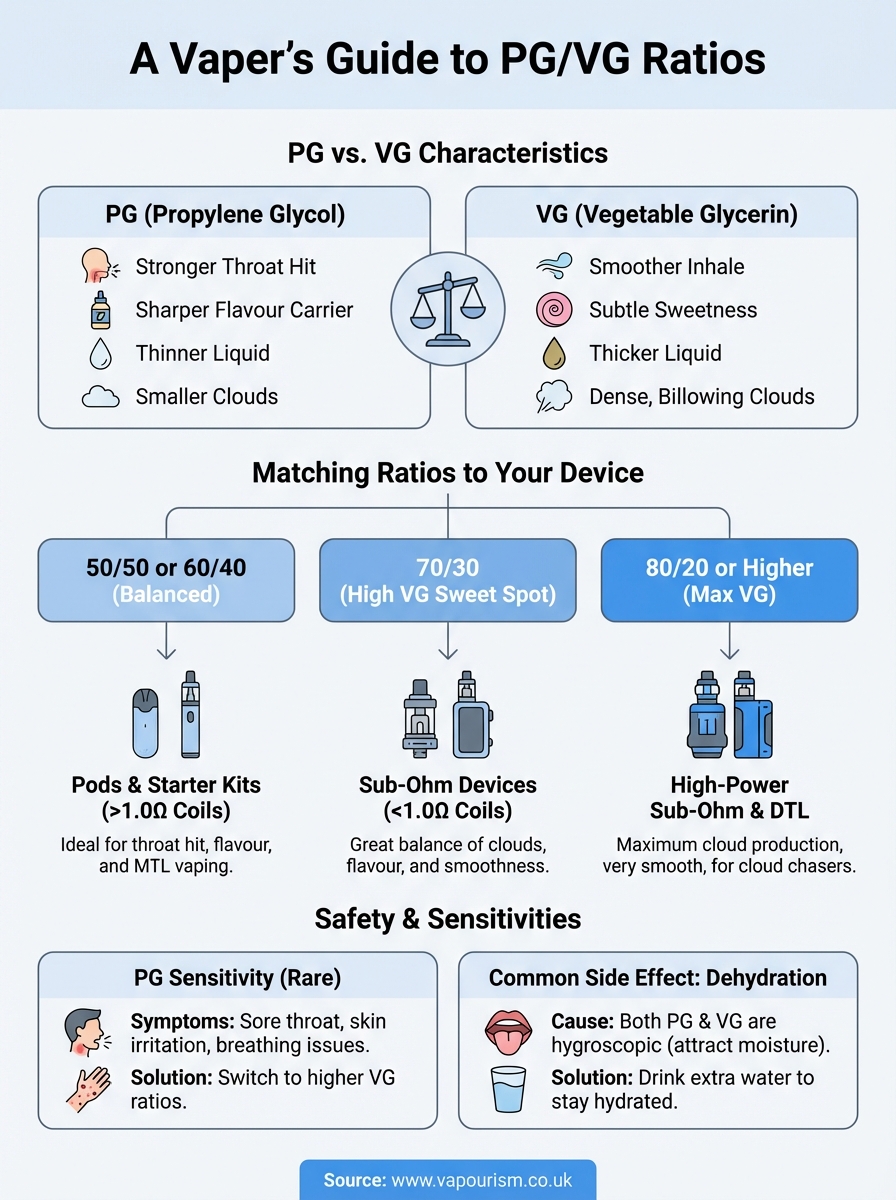
The balance between PG and VG fundamentally alters three core aspects of your vaping experience. PG acts as a superior flavour carrier because its thinner consistency allows flavourings to shine through without interference, whilst VG adds a subtle sweetness that can either complement or muddy your e-liquid's intended taste profile. Your throat hit intensity depends heavily on PG content since this ingredient creates that sharp sensation at the back of your throat, whereas VG produces smooth, dense vapour that feels gentle on your airways. Understanding these differences helps you predict exactly how an e-liquid will perform before you buy it, saving money on ratios that don't match your preferences.
PG carries flavour intensity whilst VG smooths it out
PG's molecular structure allows it to dissolve and carry flavour concentrates more effectively than VG, which means 50/50 or high-PG liquids deliver sharper, more defined taste profiles. When you vape a 60/40 PG/VG strawberry e-liquid, you'll taste distinct berry notes with noticeable tartness and sweetness. That same flavour in an 80/20 VG/PG ratio tastes softer and rounder because the thicker VG partially masks subtle flavour notes whilst adding its own faint sweetness. This doesn't mean high-VG liquids lack flavour entirely, but flavourists compensate by using higher concentrate percentages in vg a dominated blends to maintain flavour intensity.
Your device's power level also affects how VG and PG express flavours differently. Higher wattages vaporise more liquid per puff, which helps bring out flavours in thick VG liquids that might taste muted at lower temperatures. Sub-ohm vapers running 70/30 or 80/20 ratios at 60-80 watts often report intense flavour despite the high VG content because the increased vapour production delivers more flavour molecules to your taste buds with each inhale.
Throat hit differences between PG and VG ratios
PG creates the physical sensation at the back of your throat that mimics cigarette smoking, which is why smokers switching to vaping prefer 50/50 or higher-PG ratios initially. This throat hit comes from PG's slightly irritating properties that trigger nerve endings in your throat and airways. Ratios of 60/40 or 70/30 PG/VG deliver pronounced throat sensation that satisfies nicotine cravings more effectively for recent ex-smokers who need that familiar harshness. VG produces almost no throat hit on its own, creating a smooth, creamy inhale that feels gentle even at higher nicotine strengths.
Higher PG ratios replicate the cigarette-like throat sensation that helps smokers transition to vaping.
The combination of ratio and nicotine strength determines your overall throat hit intensity. A 50/50 liquid with 12mg nicotine hits harder than an 80/20 VG liquid with 3mg, even though the PG content differs. Experienced vapers often choose high-VG ratios with lower nicotine for all-day vaping because the smoothness prevents throat irritation during frequent use, whilst keeping a high-PG setup with stronger nicotine for quick satisfaction when time is limited.
How VG percentage controls cloud density
VG's thick, viscous nature produces significantly more vapour than PG when heated, which is why cloud chasers exclusively use ratios of 70/30 or higher. The molecule's structure creates dense, white clouds that linger in the air longer than the thin wisps PG-heavy liquids produce. When you exhale a lung full of 80/20 VG liquid from a sub-ohm tank, you'll see thick plumes that obscure your surroundings temporarily. That same device with 50/50 liquid produces half the visible vapour even at identical power settings, making it perfect for discreet vaping in public spaces.
Cloud production depends on both VG content and device capability. Your basic pod system running 50/50 liquid creates modest vapour regardless of power because the coil and airflow aren't designed for cloud production. Upgrading to an 80/20 ratio in that same pod often causes dry hits rather than bigger clouds because the thick liquid can't wick fast enough. Sub-ohm devices with wide-bore drip tips and adjustable airflow are engineered specifically to handle high-VG liquids, turning that thickness into the massive vapour clouds competitive vapers produce during tricks and competitions.
Matching PG/VG ratios to your vape device
Your device's design dictates which PG/VG ratios will work properly and which will cause burnt coils, leaking or weak vapour production. Using the wrong ratio in your hardware isn't just inconvenient; it wastes money on replacement coils and ruins perfectly good e-liquid. Coil resistance, wicking material and airflow design determine whether your device can handle thin 50/50 liquids, thick 80/20 blends, or anything in between. Manufacturers rarely advertise this compatibility clearly, so understanding the relationship between your hardware specifications and liquid viscosity helps you avoid frustrating trial-and-error purchases.
Pod systems and starter kits work best with balanced ratios
Pod devices and basic vape pens feature small coils with narrow wicking channels that struggle to absorb thick, high-VG liquids quickly enough between puffs. These systems perform optimally with 50/50 or 60/40 VG/PG ratios that flow easily through compact wicking material. Your basic pod mod running nicotine salts typically uses 1.0Ω to 1.8Ω coils designed specifically for these thinner liquids, delivering satisfying flavour and throat hit without requiring high power. Attempting to use 70/30 or 80/20 ratios in these devices causes the wick to dry out faster than vg a thick liquid can replenish it, resulting in burnt-tasting hits that ruin your coil within days instead of the week or two you'd normally expect.
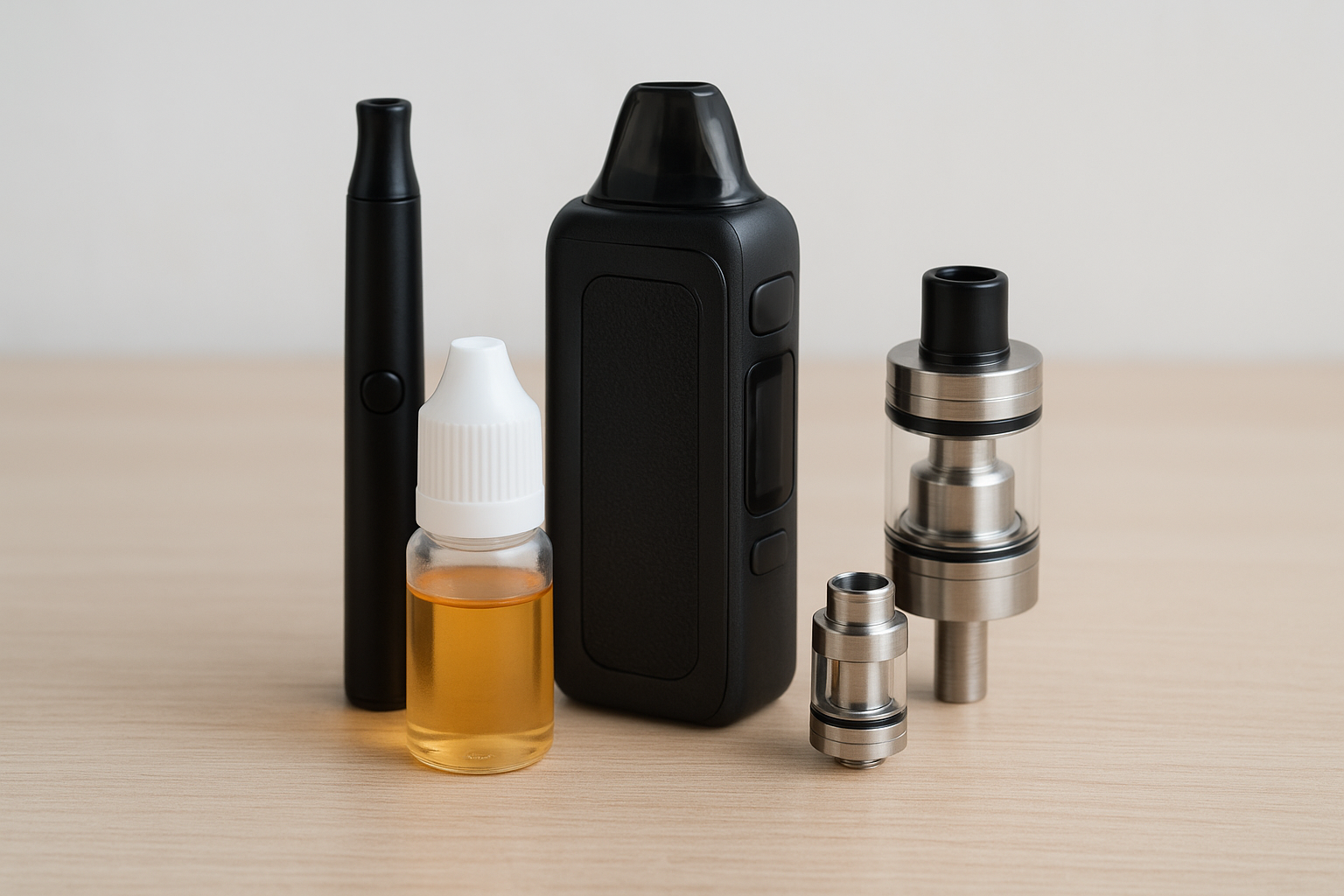
Mouth-to-lung (MTL) devices also suit balanced ratios because they replicate cigarette-style vaping with restricted airflow and lower power output. These kits work between 10 to 20 watts, which isn't enough heat to vaporise viscous high-VG liquids efficiently. Stick to 50/50 ratios in any device smaller than your palm or with fixed, non-adjustable airflow to ensure consistent performance and proper coil longevity.
Sub-ohm tanks require high-VG liquids
Sub-ohm devices with coils below 1.0Ω resistance produce significantly more heat and vapour, which means they're engineered for thick, high-VG e-liquids. These tanks feature large wicking ports and cotton channels that handle 70/30, 80/20, or even maximum VG ratios without dry hits. Your sub-ohm setup running at 50 to 100 watts needs that thicker liquid to prevent leaking, since the wider airflow and larger juice channels would allow thin 50/50 liquids to flood the coil chamber. Most vapers find 70/30 VG/PG the sweet spot for sub-ohm vaping because it provides excellent cloud production whilst maintaining enough PG for flavour definition.
Direct-to-lung (DTL) vaping styles pair perfectly with high-VG ratios since you're inhaling larger volumes of vapour straight into your lungs. The combination of low resistance, high power and wide-open airflow transforms thick VG into massive clouds that 50/50 ratios simply cannot produce at any wattage.
Match your VG ratio to your coil's resistance: above 1.0Ω use 50/50, below 1.0Ω use 70/30 or higher.
Check your coil specifications before buying e-liquid
Your coil packaging lists recommended wattage ranges that indicate which ratios work best. Coils rated 10 to 15 watts need thinner liquids around 50/50, whilst coils designed for 40 to 80 watts require 70/30 or higher VG content. When you're unsure, start with 60/40 VG/PG as a middle ground that performs adequately in most devices without causing immediate problems. Pay attention to how your coils perform: if they're burning out within two days, your liquid is likely too thick for your device's wicking system.
Safety, side effects and PG or VG sensitivity
Both PG and VG are generally recognised as safe for consumption by regulatory bodies including the UK's Food Standards Agency and the WHO, but inhaling these ingredients through vaping is relatively new compared to their use in food and medicine. Neither substance is toxic or carcinogenic, which means your e-liquid's base ingredients won't harm you the way cigarette smoke does. However, individual sensitivity varies significantly between vapers, and some people experience adverse reactions to either PG or VG that force them to adjust their ratio choices or stop vaping particular blends altogether. Understanding these potential issues helps you identify whether symptoms you're experiencing come from your e-liquid composition or other factors.
Common side effects both ingredients cause
Dehydration is the most frequent side effect vapers report, affecting users regardless of their PG/VG ratio. Both ingredients are hygroscopic, meaning they attract and hold water molecules, which pulls moisture from your mouth and throat tissues as you vape. You'll likely notice a dry mouth, increased thirst, or a scratchy throat sensation, especially during your first weeks of vaping or after extended sessions. Drinking extra water throughout the day typically resolves these symptoms within a few days as your body adjusts to regular vaping.
Some vapers experience mild headaches or dizziness when they first start using high-VG liquids, though this usually stems from nicotine strength rather than the VG itself. Reducing your nicotine level or taking shorter, less frequent puffs helps your body adapt without forcing you to change your preferred ratio.
Staying properly hydrated prevents most common vaping side effects regardless of your PG/VG ratio.
Recognising PG sensitivity or allergy
PG sensitivity affects approximately 3% to 5% of vapers, causing symptoms ranging from mild throat irritation to severe allergic reactions. You might experience persistent sore throat, skin rashes, breathing difficulties, or swelling after vaping PG-heavy liquids. These symptoms worsen with continued exposure rather than improving as your body adjusts, which distinguishes true sensitivity from normal beginner side effects. Switching to high-VG or maximum VG ratios immediately resolves symptoms for most people with PG sensitivity, though checking that your e-liquid uses VG-based nicotine rather than PG-suspended nicotine matters too.
Testing involves gradually increasing VG content in your liquids. Start with 70/30, then try 80/20, and finally maximum VG if symptoms persist. Most vapers with PG sensitivity find relief at 80/20 or higher, allowing them to continue vaping comfortably.
When VG causes problems
VG sensitivity is significantly rarer than PG reactions, but vapers allergic to specific plant oils might react to VG derived from those sources. Symptoms include throat irritation, breathing difficulties, or digestive issues if you accidentally ingest e-liquid. Coconut-derived VG causes problems for people with coconut allergies, whilst soy-based VG affects those sensitive to soy products. Contacting your e-liquid manufacturer to confirm their VG source helps you avoid vg a derived from plants you're allergic to, or you can switch to synthetic glycerin-based liquids if available.
Bringing it all together
Understanding VG and PG ratios transforms vaping from guesswork into informed choices that match your device, preferences and goals. Your ideal ratio depends on whether you prioritise cloud production, throat hit, flavour intensity or smoothness, and knowing how vg a component affects each aspect helps you select e-liquids confidently. Start with 50/50 ratios if you're transitioning from smoking or using basic devices, then experiment with higher VG percentages as you upgrade to more powerful hardware. Pay attention to how your coils perform and how your throat feels after extended sessions, since these signals indicate whether you need to adjust your ratio or address potential sensitivity issues.
Choosing the right e-liquid ratio matters as much as selecting quality devices and authentic products. Browse our premium e-liquid collection to find verified, batch-tested options across every VG/PG ratio, backed by expert guidance and fast UK delivery that gets your order to you the next day when placed before 1 pm.